What if the Machine Finally Understands Me?
I have spent a surprising amount of my life around technology for someone who has never really known how to write software. Long before AI became something everyone talked about, I was downloading open-source projects, installing things on servers, trying software that probably had no business being installed by someone with my level of technical training, and generally figuring things out by seeing if I could make them work. I have probably downloaded thousands of repositories over the years. I could usually understand what something was supposed to do, and with enough persistence I could often get it running. What I could never really do was code.
I tried more than once. The concepts usually made sense to me, but the process never moved fast enough for the way my brain seems to work. I would have an idea, get excited about where it could go, and then find myself spending an hour trying to figure out why something would not compile or why one little piece of syntax was wrong. By the time I solved the problem, I had often lost the energy I had for the idea itself. That probably says more about me than it does about programming, and that is important to this story, because I do not want any of this to sound like a criticism of the programmers or developers I have worked with over the years. If anything, it is a bit of a confession.
I have not always been particularly good at getting what is in my head into somebody else’s. I can have something that feels completely clear to me. I can see how it should work, why it matters, what the person using it should experience, and where it should eventually lead. Then I explain it to somebody, draw it, mock it up, show them something similar, explain it again, and somehow what seemed obvious inside my own head still has not made the trip into theirs. My reaction over the years was sometimes frustration. Why are they not seeing this? With a little age, and probably a little humility, I have begun to recognize the more useful question. Why am I not explaining this in a way they can see?
There have certainly been exceptions. Around the dot-com period in particular, I had a great run working with people who seemed able to hear one of my wandering descriptions, understand where I was trying to go, and somehow turn it into something real. I am still not entirely sure what made those relationships work so well. Maybe they thought a little like I did. Maybe they were unusually good listeners. Maybe they knew which parts of what I was saying mattered and which parts they could safely ignore. If you happen to be one of those people and you are reading this, you probably know who you are. Those experiences proved to me that the gap could be crossed. The right person could somehow get inside the idea with me.
Looking back, I think I have been trying to solve that gap for most of my life without really knowing that was what I was doing. Even when I thought I was starting with a blank sheet of paper, I rarely actually was. I was always looking for pieces I could use to get a head start. Something that almost did what I wanted. A database I could bend a little. A tool that solved one part of the problem. Some software somebody else had already written that might become the beginning of something completely different.
One of my earliest memories of this was playing with HyperCard on a very early Macintosh. The next day, almost by accident, I met with a very large organization that had a completely different problem. They had a methodology called SAM spread across something like 24 binders, and they wanted a better way to put all of that information in the hands of consultants in the field. They needed somebody to be able to get to the right piece of the right binder at the right time, and they were also looking at optical media, which at the time felt pretty exotic.
I did not know enough to think what they wanted was particularly difficult, so I started gluing things together. We converted the documents into an open format, put them onto optical media, created an index in a database, and used HyperCard as a simple front end so a consultant could navigate the information without needing to understand any of what was happening underneath. I certainly did not invent any of those technologies. I did not write HyperCard, invent databases, or create optical storage. I just looked at several things sitting on the table and thought they ought to be able to work together.
And they did. We built something useful, meaningful, and surprisingly fast for a very large organization.
I sometimes wonder whether not knowing more was actually helpful. Formal computer science training would obviously have given me skills I did not possess, but maybe there were occasions when ignorance gave me a little freedom too. I did not know enough to understand all the reasons something was not supposed to be done a certain way. I was not particularly interested in whether I was using the proper architecture. I mostly wanted to know whether we could make the thing work.
That became a pattern. I was always attracted to technologies that shortened the distance between an idea and a working result. Some people will remember the early rapid application development tools. I played with Tango and Tango Query, ACIUS 4D, NeuralWorks Explorer, and the free-form database tools from Lotus, along with plenty of others I have probably forgotten. What fascinated me about those systems was that they gave someone like me a way to get closer to the thing I was imagining without first becoming a computer scientist. Give me a database, some visual tools, some logic, and a way to connect things, and suddenly I could make something happen.
Those tools always felt like glimpses of a future I wanted. They moved some of the technical machinery farther into the background, which meant I could spend a little more time thinking about the problem and a little less time thinking about the mechanics. Eventually, though, you still reached the edge of what the tool could do, and somebody who really knew how to program often had to take over.
Then, a few years ago, low-code arrived and I thought maybe we were finally there.
I spent a ridiculous amount of money trying to build something in Bubble. And honestly, it got incredibly close. For the first time, I could build fairly sophisticated software without really being a programmer. I could create screens, workflows, databases, relationships, and logic. Compared with what had come before, it was remarkable. But there was still one problem that mattered a lot to me. I could not simply tell it what I wanted.
I still had to draw everything, click everything, define the fields, think through the data structure, create the relationships, and tell every workflow exactly what needed to happen. I could do it, and I did do it, but that was never the part that interested me. I care about what the thing is supposed to accomplish. I care about the problem, the experience, what happens when somebody pushes the button, and whether the result is actually useful. I do not particularly care which table a field belongs in or how many internal steps have to fire for something to happen correctly.
Bubble made me feel as though I had finally walked right up to the edge of what I had been looking for all those years. I was standing on the precipice, but the fog bank was still there. I could sense what was on the other side. I could get closer than I ever had before. But I still had to translate the idea in my head into the language of the tool before the tool could do anything useful with it.
That is what feels different now.
For the first time, I can begin with the idea itself. I can talk through a problem the way I naturally think about it. I can explain what I am trying to accomplish, why the current way does not work, what I wish happened instead, and what I think the result should feel like. I can wander a little. I can change my mind halfway through. I can use the wrong terminology. I can give an example that only partially fits and then say, no, that is not really what I mean.
The conversation does not have to end there.
In fact, I have learned that one of the best things I can do is tell the AI not to quietly fill in the important gaps. Ask me questions. Tell me what you think I mean. Show me where two things I said conflict with each other. Ask me which part matters more. Tell me what you need to know before you make an important decision. That has become one of the most useful parts of AI for me, because sometimes the problem is not that somebody else cannot understand the idea. Sometimes I have not completely thought it through myself.
An idea can feel finished in my head because I can see the destination, even though I have not worked through everything required to get there. AI seems unusually comfortable living with me in that messy middle. I can ramble through the muddy thoughts, pull them out into the daylight, and start reacting to them. That part is right. That is not. This matters more than I thought. Forget that part. What if we tried this instead? Slowly, the idea starts finding its shape.
And now, increasingly, the machine can do something with it.
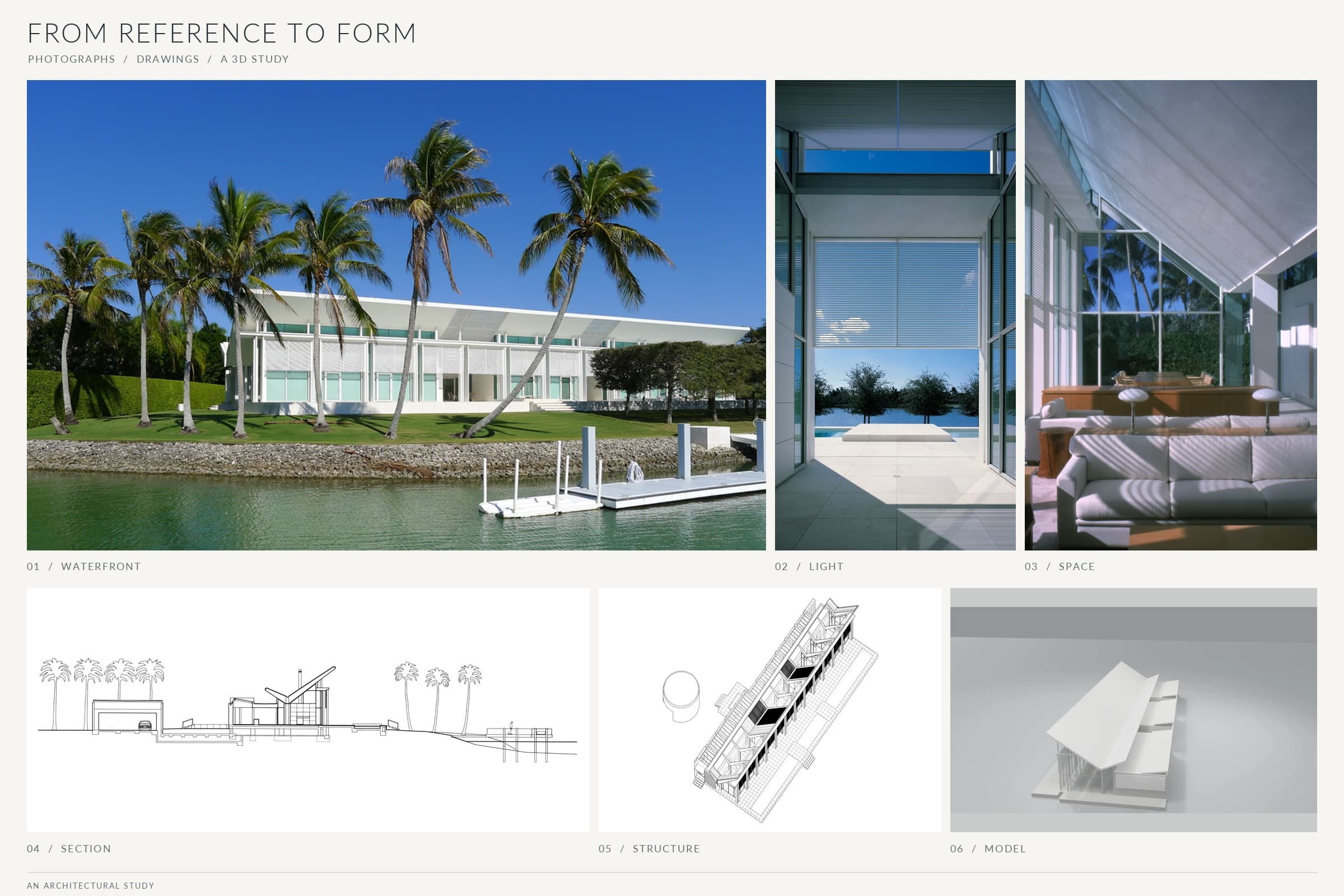
A recent example had nothing to do with software. I have always loved architecture, particularly the work of Richard Meier, and one house I have admired for years is the Neugebauer House in Florida. I have always wanted to design and build something influenced by it someday. Not a copy, but something that used the house as a point of departure.
Until recently, that idea would mostly have lived in my head, along with some pictures, drawings, and rough dimensions I had collected over the years. A few days ago I handed Astra images of the house from several angles, along with drawings and some approximate measurements, and asked it to use Python through MCP to control Blender and build a three-dimensional model based on what I had given it.
That sounds much more technical than what I actually did. What I essentially said was: here are some pictures, here are some dimensions, here is the thing I am interested in, can you make me a 3D model so I can start playing with the idea?
And then something close to magic happened. It built it, and then I could fly around it and through it.
It was not a finished house and I certainly was not going to hand it to a contractor the next morning. That was not the point. The point was that something I had carried around in my imagination for years suddenly had form. I could look at it, react to it, change it, move something, rotate something, put it on another site, alter the proportions, and start asking much better questions. The thought had become something I could work on instead of something I could only imagine.
That experience has had me thinking about what may really be changing. Can I paint the pictures in my head well enough with words that a machine understands what I mean? Not just the literal words, but the intention behind them. Can it understand me even when I am not concise? Can it hear the half-finished thought, recognize what I am reaching for, ask enough questions, and have enough patience to help me pull the idea the rest of the way out?
Maybe the real breakthrough for someone like me is that I no longer have to speak the machine’s language perfectly. The machine may be getting good enough to learn mine.
That reminds me of another technology that gave me a similar feeling years ago. When I first became involved with electric vehicles, I was fascinated by the high-performance side. We were building cars and motorcycles, experimenting, going fast, and generally having quite a lot of fun. Then electric bicycles started showing up. At first I simply thought they were interesting, and then I rode one.
What surprised me was not the motor itself. It was how the motor changed my relationship with riding. Suddenly I did not have to think nearly as much about whether I could make it up a particular hill, whether I had gone too far to comfortably get home, or whether a route was more ambitious than I wanted to attempt that day. I could still pedal hard. I could ride for a couple of hours and get a great workout. But I was no longer limited by the course in quite the same way.
It felt like somebody had given me a modest superpower.
The bike was not riding itself. I was still on it, still pedaling, and still deciding where to go. It had simply removed one of the limitations that used to determine where I could go in the first place.
That may be the closest analogy I have found for what AI feels like to me right now. It does not have to replace the experience of making something. It can expand what I am capable of making.
There is another part of that which I did not expect. I actually like seeing the work happen. If I say a few words and a finished image suddenly appears, that is impressive, but there is something almost more gratifying about watching the idea being worked on. Seeing the model get built, watching the tests run, seeing the machine encounter a problem, try something, correct itself, and keep moving. You get a sense that real work is being accomplished on your behalf.
I think there is still authorship in that.
Obviously I am not comparing this experience to Michelangelo carving marble with his own hands. There must be extraordinary satisfaction in having the skill to turn a block of stone into something beautiful yourself. I do not have that skill. But if I could describe a sculpture that exists in my imagination, work through it with an intelligent system, challenge what it creates, refine it until it resembles what I am seeing in my head, and eventually have that system drive a CNC machine that produces the sculpture, I suspect I would still feel an enormous sense of creation.
I would not suddenly claim to be Michelangelo. But the thing would not exist without the idea, the choices, the corrections, and the intention I brought to it.
Lately I have been building software for my company, although “building software” is becoming a strange phrase for what I am actually doing. I am not sitting at a keyboard writing thousands of lines of code. I am the person with the problem, the customer, the product manager, sometimes the IT department, and eventually the tester. I am the guy saying, that is close, but it is not what I meant. Let me explain it differently.
And somehow I am also the developer, at least in the broadest sense of the word, because the software is being developed under my direction.
The results so far have been remarkably good, at least by my standards, because they are producing the outcomes I wanted, and they are happening quickly enough that I remain engaged with the idea. I did not realize how important that last part was. Traditional programming always felt as though there was too much distance between the thought and the result. I would get excited about the destination and then bog down in the mechanics required to move three feet toward it.
AI has shortened that distance dramatically.
It gives me the same feeling the electric bicycle did. I can suddenly consider routes I would have dismissed before.
That has started making me think about a much more ambitious project I want to undertake. Even a year ago I would have described it by saying that I wanted to build it. I am realizing now that is not really what I mean. I do not particularly want to build it in the traditional sense. I want to define it.
I want to explain the problem, the opportunity, the experience, the information available, the decisions that need to happen, and what success should look like. Then I want the collective intelligence available through AI to help determine how to make it real. I want an architect thinking about the overall software structure, somebody thinking deeply about the data, somebody worrying about security, somebody questioning the interface, and somebody else testing what was built, deliberately trying to break it, finding what does not work, and sending those problems back to be fixed.
Historically, that might have meant assembling a substantial team. Increasingly, it may mean orchestrating a substantial team of agents. And perhaps my role is not to tell each one exactly how to do its job. Maybe my role is to make sure they all understand what we are trying to accomplish.
That is where my perspective on AI seems to differ from a lot of what I am reading. There is tremendous discussion about which jobs AI will replace, and I understand why. When machines become capable of doing things that previously required highly trained people, there is going to be disruption. I do not think optimism requires pretending otherwise.
But when I look at exactly the same technology, the first thing I see is not everything people may no longer be needed to do. I see everything more people may suddenly become capable of doing.
I think about the HyperCard project all those years ago, when I could take several existing technologies, glue them together, and solve a useful problem even though I could not have built any one of those technologies myself. I think about the RAD tools that let me get a little closer. I think about Bubble, standing on the precipice with the fog bank still surrounding me. Then I look at what I can do today, this week, and it feels as though some of that fog is finally beginning to clear.
I think about all the things I have wanted to make but did not have the skill to make. I think about ideas that stopped because I could not code them. I think about small businesses that could never justify having a software department, a designer, a data scientist, a management consultant, a researcher, and a security expert. I think about everything inside my own company that we know could be better but has always competed against limited time, limited money, and limited people.
What happens when all of us suddenly get an electric motor on the bicycle?
I do not think the interesting answer is that we stop pedaling. I think the interesting answer is that we start wondering where else we can go.
There is a trap in all of this, particularly for somebody like me. AI can be very agreeable, and I generate enough ideas on my own without surrounding myself with artificial intelligence telling me every one of them is brilliant. What I actually need is the opposite. I want the virtual engineer to tell me I am making something unnecessarily complicated. I want the virtual CFO to tell me the economics do not work. I want the customer advocate to ask why anybody would use it. I want the security person to tell me what I have overlooked. And when I have failed to explain something clearly enough, I want the system to stop and ask me another question instead of quietly inventing whatever is missing.
Because again, sometimes the communication problem is me. Probably more often than I would like to admit.
This is not a story about programmers failing to understand me. It is a story about how difficult it can be for any of us to take something we can see clearly inside our own head and transfer it intact into someone else’s. The people who were especially good at doing that with me over the years were incredibly valuable. What has me excited today is the possibility that this translation layer may now be available to almost anyone.
Maybe I do not have to know all of the right words. Maybe I can start with intention. Maybe I can explain what I am trying to accomplish imperfectly, and the machine can help me discover what I actually mean. It can ask questions, expose contradictions, compare the idea against countless ways similar problems have been approached, and eventually help turn that cloudy description into something precise enough to engineer.
Then it can help engineer it.
For most of my life, the question was, can I build this? Later it became, can I find the right people who can build this? Now I find myself asking something different.
Can I paint the picture in my head well enough that an intelligent machine understands my intention, and if I cannot do it on the first try, can it be patient enough to keep asking until we get there?
If the answer to those questions is yes, then the technical skill I have always lacked may no longer be the wall it once was. Maybe not knowing how to program was sometimes the thing that held me back. Maybe not knowing what I was supposed to consider impossible was occasionally an advantage too.
AI seems to bring those two parts of my history together. It lets me start the way I have always started, with an idea, a problem, some pieces that might fit together, and the conviction that there is probably a way to make it work.
Only now, for the first time, I can talk to the pieces.
And they can talk back.
The machine does not give me somebody else’s superpower. It seems to amplify the one I already had.
Ideas.
And for someone who has spent most of his life carrying around far more of those than he has ever had the time, patience, or technical ability to pursue, that may be the most exciting part of AI yet
— CraigMore field notes ↗