Hi, My Name is Craig… and I Can’t Fix It
I’ve always thought of myself as a solution guy.
Not because I always have the answer. Most of the time I don’t. But I’ve always believed that if you give me enough time, enough books, enough conversations with smart people, and now a little AI, I’ll eventually find one. Somebody, somewhere, has already wrestled with this problem. My job is to find them, borrow the best ideas, stitch them together, and see if I can make them work.
Unfortunately for my family, this usually ends with me explaining every possible solution, ranking them in order, and then casually presenting my favorite as though it were common knowledge all along.
My wife has learned not to ask me simple questions.
“What vacuum should we buy?”
Forty-five minutes later I’ve read every review, watched six YouTube videos, called a vacuum repair shop, and have developed strong opinions about cyclone technology.
Apparently this isn’t normal.
I genuinely thought everyone did this.
Looking back, I’ve spent most of my life solving problems. I enjoy it. I love the hunt almost more than the solution itself. A complicated business issue, a technical challenge, a relationship conflict, a financial puzzle—they’re like giant jigsaw puzzles that somebody dumped on the floor. My instinct is to sit down and start finding the corner pieces.
For years, I assumed that’s just how I was wired.
Then, in my twenties, while I was reading everything I could find about personal growth, psychology, leadership, and why people become who they become, someone asked me a question that has stayed with me ever since.
It led me back to a memory I hadn’t thought about in years.
I was probably nine or ten years old.
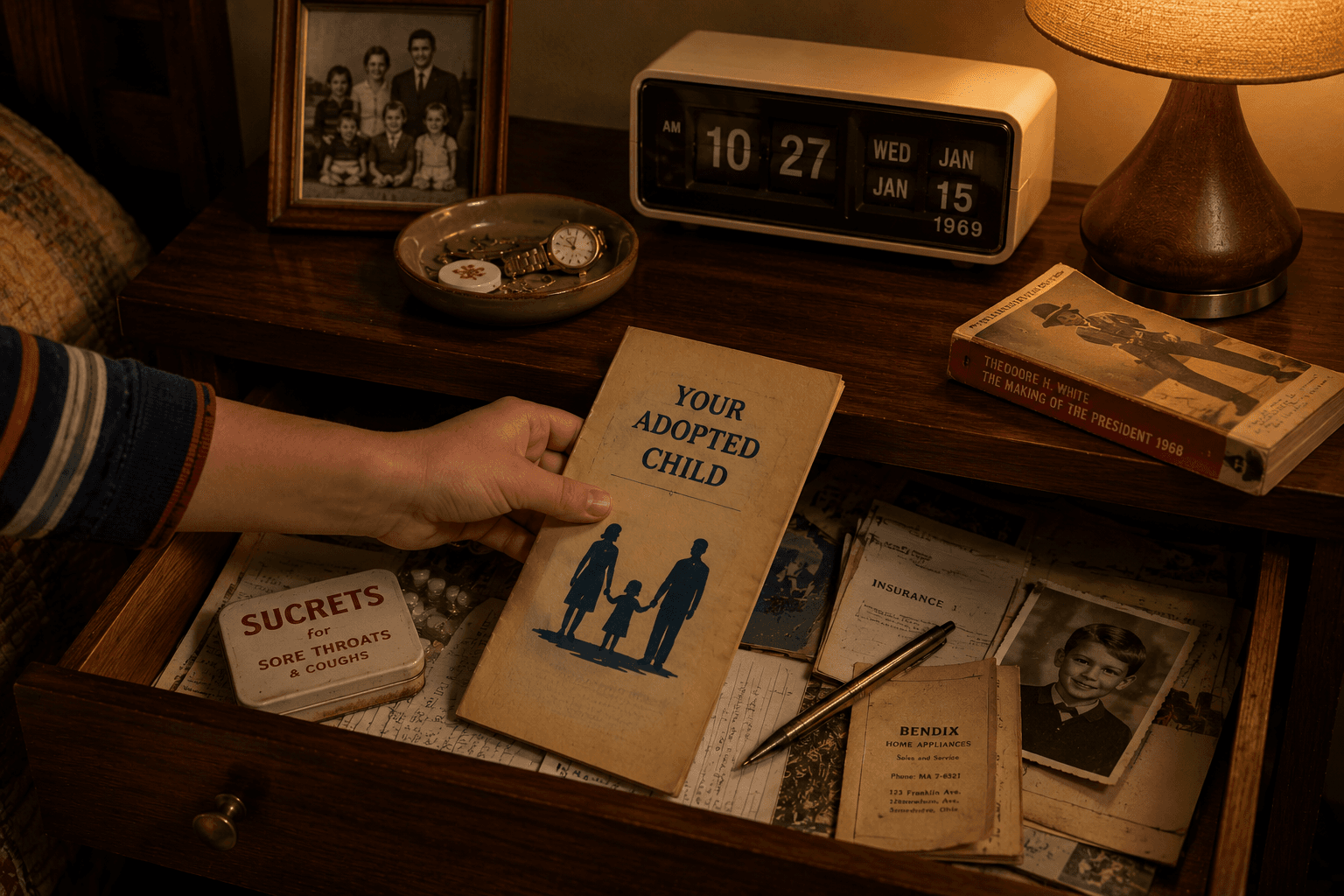
I had a terrible cough and was rummaging through my mom’s nightstand looking for Sucrets cough drops. As a side note, years later I realized it probably wasn’t a cold at all. It was secondhand cigarette smoke. Different decade. Different parenting philosophy.
I never did find the Sucrets.
Instead, buried underneath a stack of papers, I found a small pamphlet. I don’t remember the exact title, but it said something like, “Your Adopted Child.”
Being the observant little detective that I was, I immediately marched into the kitchen.
“Mom,” I announced with all the confidence a ten-year-old can muster, “why didn’t you tell me my sister was adopted?”
I’ll never forget her face.
The color drained from it.
Then, as I watched her expression, I felt the blood drain from mine.
It wasn’t my sister.
It was me.
Even after all these years, that moment feels strangely foggy. I don’t remember crying. I don’t remember feeling angry or rejected. What I remember is trying to make sense of something that completely rearranged the world as I understood it.
And somehow, my ten-year-old brain landed on this:
“Awesome. I saved my sister from being adopted.”
Now, before you spend too much time analyzing the logic of that statement, remember that ten-year-olds aren’t exactly known for their reasoning skills.
Kids don’t process life with logic.
They process it with stories.
Somewhere in that moment, whether it was true or not, I wrote a story that made sense to me.
I solved a problem.
Looking back now, I sometimes wonder if that story became part of my operating system.
Not because it was true.
Because I believed it.
For the next forty or fifty years, I became the guy who solved problems.
Business rewarded that instinct.
Starting companies rewarded it.
Friends appreciated it.
Employees appreciated it.
If someone had a problem, I genuinely wanted to help. There was never any hidden agenda. I simply loved taking something complicated and making it understandable. I loved finding patterns. I loved discovering solutions.
It felt like I was doing exactly what I was supposed to be doing.
Then life became more complicated.
Business problems are wonderfully cooperative.
If sales are down, you can study the market.
If a process is broken, you redesign it.
If cash flow is tight, you find new customers or reduce expenses.
Those problems don’t always have easy answers, but they usually have answers.
People are different.
Children are different.
The people you love most are different.
Over the past several years, I’ve found myself sitting across from people I love deeply, looking at situations that seemed so painfully obvious to me.
If they would just make this phone call.
Have this conversation.
Take that first step.
Ask for help.
Believe in themselves.
I could see the path so clearly.
So I did what I’ve always done.
I researched.
I thought.
I offered ideas.
I encouraged.
Sometimes I even built the plan.
And then…
Nothing happened.
At first I was frustrated.
Not with them.
With myself.
Surely I hadn’t explained it well enough.
Surely I hadn’t found the right article.
The right analogy.
The right encouragement.
The right book.
The right conversation.
After all, problems are meant to be solved.
Right?
It has taken me much longer than I’d like to admit to realize that there are some problems you cannot solve because they don’t belong to you.
You can love someone completely and still be unable to change their choices.
You can have the experience, the wisdom, the resources, and even the right answer.
None of that gives you the ability to live someone else’s life.
That has been surprisingly difficult for me.
Maybe because, somewhere along the way, I quietly confused being helpful with being valuable.
Maybe I believed that if I could solve enough problems, I had earned my place.
I don’t know.
I’m still sorting that part out.
What I do know is that I’m slowly learning something I wish I had understood years ago.
Sometimes people don’t need another solution.
Sometimes they just need someone willing to sit beside them while they discover their own.
For someone who has spent a lifetime believing every problem has an answer, that has been a humbling realization.
I still love solving problems.
I hope I always will.
But I’m beginning to think that the people who have mattered most in my life were never asking me to fix them.
They were simply asking me not to leave while they figured it out.
That turns out to be much harder.
And, if I’m honest, probably much more important.
— CraigMore field notes ↗