Fishing Altered States and Optimism
There is something magical about the night before a fishing trip.
I was thinking about that tonight while organizing a fly box.
It doesn’t seem to matter whether I am ten years old or sixty-five years old. The feeling is exactly the same. There is this nervous excitement that starts to build as the gear comes together. You check the rods. You organize flies that probably don’t need organizing. You think about where you might fish. You check the weather forecast even though you know full well that fish rarely cooperate with weather forecasts.
And then when you finally go to bed, your mind won’t quite shut off.
Tomorrow might be the day.
The funny thing is that I don’t think it is really about catching fish anymore.
When I was young, catching fish was absolutely the objective. Bigger was better. More was better. Every fish was a victory. Today, I rarely keep fish unless I’m somewhere in the ocean where there is an abundance and the fish is destined for dinner later that evening. What excites me now isn’t really the fish themselves.
It’s the anticipation.
It’s wondering what might happen.
It’s the possibility.
Some of my earliest memories revolve around fishing. My dad wasn’t much of a fisherman, but he knew how much I loved it. We had a little place at the Lake of the Ozarks that was barely what most people would call a cabin. It was essentially one room with a bathroom attached, but to me it was paradise.
There was a floating dock in front of it, and underneath that dock we eventually embedded lights into the Styrofoam flotation. At night those lights would shine down into the water, and every evening there was a predictable progression that fascinated me.
First came the tiny fish.
Thousands of them.
Then slightly larger fish would appear and begin feeding on those fish.
Eventually the white bass and stripers would show up and completely change the mood underwater. The water that had seemed calm and orderly would suddenly erupt into chaos as predators tore through the schools.
I could watch it for hours.
What I realize now is that I wasn’t really just watching fish. I was watching possibility. I was watching a puzzle. I was trying to understand how things worked.
Fishing occupied an enormous amount of my brain in those days. I loved organizing tackle boxes and fly boxes. I loved reading about fish. I loved thinking about fish when I wasn’t fishing.
At one point I became obsessed with catching striped bass.
The guys at the bait shop told me the best way was with live shad. The problem was that shad were expensive, and I was a kid. So I decided I would catch my own.
That led to an entire summer of frustration.
I bought a cast net and spent countless hours trying to master it. Most of the time I was lucky if the thing even opened correctly. The shad seemed almost supernatural. They would move across the surface in schools that reminded me of flocks of birds. One second they would scatter in every direction and the next they would all move together as if they shared a single brain.
No matter what I did, they never seemed interested in swimming into my net.
Eventually I asked about flies.
Could I catch stripers on a fly rod?
The answer was immediate.
“No.”
Of course this was Missouri in the early 1970s. This wasn’t exactly a fly-fishing mecca. The answer wasn’t malicious. It was simply accepted wisdom.
But something about that answer stuck with me.
Not because I disagreed with it.
Because I wondered if it was true.
So I started tinkering.
I bought a Malibu jig and gradually cut it apart. I removed the marabou and began experimenting. I took strips of clear plastic from the rings that used to hold six-packs of soda together and tied them onto the hook. Then I took a black marker and put a dark spot on the plastic to imitate the large black mark of a shad.
It wasn’t pretty.
It wasn’t elegant.
But in my mind it looked enough like a baitfish to be worth trying.
The next morning I headed out in the boat carrying my homemade creation and a long fiberglass Pflueger fly rod with an automatic retrieve reel that sounded like a coffee grinder every time you used it.
I loved that rod.
I found the shad.
I found the stripers.
And I started casting.
What happened next remains one of the clearest memories of my childhood.
The fish absolutely hammered that fly.
One after another.
I don’t remember how many I caught. I don’t remember how large they actually were. In my memory they were enormous. In reality they were probably three or four pounds.
What I remember most is how hard my heart was beating.
I wanted someone to see it.
I wanted somebody to know what had happened.
I remember sitting there with fish after fish coming to the boat, unable to stop smiling.
Looking back now, I don’t think that moment was really about fishing.
I think it was one of the first times I experienced what would later become my entrepreneurial optimism.
I didn’t know what entrepreneurship was.
I certainly didn’t know I would spend much of my life building companies.
But I remember the feeling.
Someone told me something couldn’t be done.
I spent time thinking about it.
I became curious.
I tried something.
And eventually I found a solution.
That process has repeated itself over and over throughout my life.
In motorcycles.
In technology.
In manufacturing.
In business.
And maybe that is why fishing still occupies such a special place in my mind.
Because fishing has always been about more than fish.
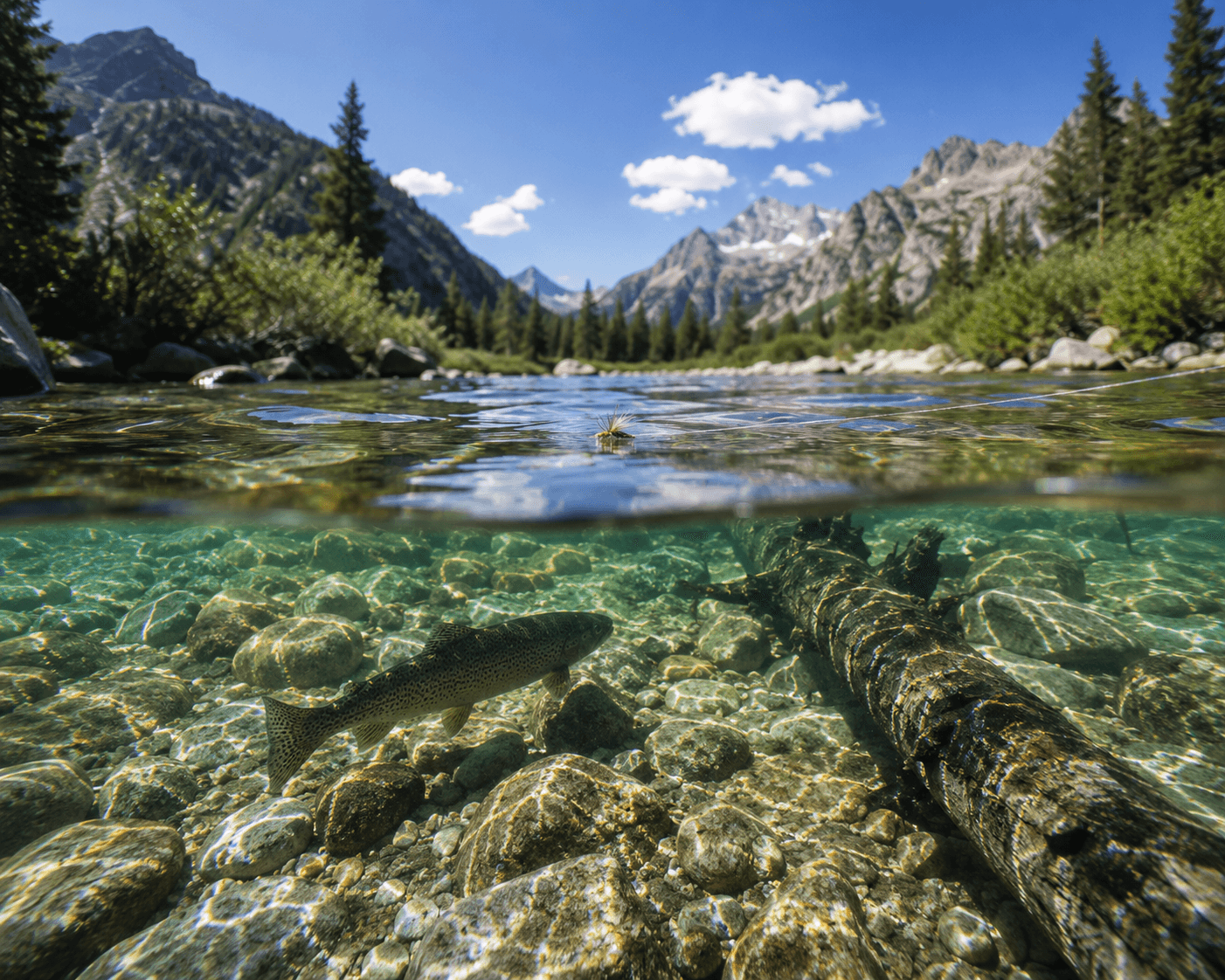
A fly lands on the water and begins drifting downstream.
You start wondering what is happening underneath it.
Is a trout watching?
Is there a fish behind that rock?
Is the fly floating naturally?
Should I mend the line?
Should I wait?
Your entire world shrinks to a few feet of water.
The deadlines disappear.
The worries disappear.
The noise disappears.
For a brief period of time your brain becomes completely absorbed in a tiny corner of the universe.
And somehow that feels restorative.
Maybe even necessary.
I have experienced similar states while sculpting. Sometimes while writing. Occasionally while building something complicated enough that everything else fades away.
Psychologists call it flow.
I don’t know what to call it.
I just know it feels good.
Maybe that’s why I still get excited the night before a fishing trip.
Maybe it isn’t really about the fish.
Maybe it is about entering that state again.
That place where curiosity becomes more important than worry.
Where imagination becomes more important than certainty.
Where possibilities seem larger than obstacles.
And where a kid sitting alone in a fishing boat still believes that if he thinks about a problem long enough, there is probably a solution waiting to be discovered.
Tomorrow might be the day.
And somehow, after all these years, that is still enough to keep me awake.
— CraigMore field notes ↗